In a professional employer-employee relationship, both parties must remain well-informed about their rights and obligations as today’s employment landscape rapidly evolves. The State of California has long been the trailblazer of worker protections—and as corporations increasingly rely on artificial intelligence (AI), biometric tracking, and algorithmic management to oversee their workforces, California lawmakers have stepped in to draw a hard line.
From massive fulfillment centers and logistics warehouses in the Inland Empire to corporate offices across Southern California, employers have increasingly turned to software to track worker productivity, monitor emotions, and even automate firing decisions. However, under a landmark trio of newly signed California laws taking effect in 2027, employers can no longer hide behind computer algorithms to violate labor laws, retaliate against workers, or execute mass layoffs in the dark.
At SANFORD A. KASSEL, A Professional Law Corporation, our experienced California employment lawyers have fought to protect the rights of wronged employees since 1981. If you have been unfairly disciplined, subjected to invasive digital monitoring, or fired due to automated workplace metrics, understanding your rights under California’s new AI employment laws is critical to protecting your livelihood.
1. The “No Robo Bosses Act” (SB 947): Ending Algorithmic Wrongful Termination
Effective Date: July 1, 2027
For years, large employers—particularly in the warehouse, logistics, retail, healthcare, and customer service sectors—have used Automated Decision Systems (ADS) to score employees, track micro-movements, and automatically generate disciplinary write-ups or termination notices when workers fall behind an algorithm’s pace.
Starting July 1, 2027, California’s No Robo Bosses Act (Senate Bill 947) makes it illegal for an employer to rely solely on an Automated Decision System when making disciplinary or termination decisions.
Key Worker Protections Under SB 947:
- Mandatory Independent Human Review: Employers cannot allow an algorithm or software program to have the final say in firing or disciplining you. Where an employer primarily relies on an ADS output to make a disciplinary or termination decision, a qualified human reviewer must independently review and corroborate the decision using the underlying data and other relevant context. If the ADS output is inaccurate, incomplete, or misleading, the employer is strictly prohibited from using it to discipline or fire the employee.
- Written Notice and Data Transparency: Whenever an employer primarily uses an ADS to discipline or terminate a worker, they must provide written notice to the employee at the time of the decision. Furthermore, employees have the legal right to request a meaningful description of the specific data the algorithm used against them.
- Ban on Algorithmic Retaliation and Discrimination: SB 947 explicitly prohibits employers from using an ADS to infer an employee’s protected status under California’s Fair Employment and Housing Act (FEHA)—such as age, disability, pregnancy, race, or gender—or to predict and punish a worker for exercising their legal rights.
How a Wrongful Termination or Retaliation Attorney Can Help
Wrongful termination cases are complex, and when employers blame an “objective computer system” for firing an employee, victims often feel powerless. In reality, automated systems frequently punish workers for taking legally mandated meal and rest breaks, using the restroom, requesting disability or pregnancy accommodations, or reporting unsafe working conditions.
When an employer uses an algorithm to mask illegal discrimination or punish a whistleblower, it constitutes wrongful termination and workplace retaliation. Speaking with an experienced wrongful termination attorney or retaliation attorney at SANFORD A. KASSEL, A Professional Law Corporation can help uncover the data behind your firing and hold your employer accountable for lost wages, lost benefits, and emotional distress damages.
2. AI Workplace Surveillance (AB 1883): Banning Emotional and Neural Tracking
Effective Date: January 1, 2027
As workplace monitoring technology has grown more aggressive, some employers have deployed AI-powered cameras, headsets, wearable sensors, and voice-analysis software designed to read workers’ facial expressions, vocal tone, fatigue levels, and stress.
Taking effect January 1, 2027, Assembly Bill 1883 (AB 1883) places strict limits on AI-enabled workplace surveillance across both private and public employers in California.
What AB 1883 Prohibits in the Workplace:
- No Emotional State Tracking: Employers are prohibited from using AI-enabled surveillance tools to recognize, infer, or predict an employee’s emotional state, mood, stress level, or attentiveness.
- No Collection of Neural Data: Employers cannot use wearable or sensor technology to collect “neural data” by measuring an employee’s central or peripheral nervous system.
- Restrictions on Facial Recognition, Gait Analysis, and Bathroom Monitoring: Companion provisions strictly forbid workplace surveillance tools in employee bathrooms and bar employers from using AI facial recognition or gait-based (walking pattern) inferences to discipline, deactivate, or terminate workers.
Violations of AB 1883 carry steep statutory civil penalties of up to $500 per violation, along with the right to seek injunctive relief, punitive damages, and reasonable attorneys’ fees.
3. Automation Mass Layoffs and Expanded Cal-WARN Notices (SB 951)
Effective Date: January 1, 2027
When companies replace human workers with AI software or automated robotics, employees are often blindsided by sudden mass layoffs or pressured into signing unfair severance agreements. Under existing California Worker Adjustment and Retraining Notification (Cal-WARN) law, covered employers must provide at least 60 days’ advance written notice before a mass layoff, relocation, or termination.
Starting January 1, 2027, Senate Bill 951 expands Cal-WARN requirements whenever a mass layoff, relocation, or termination is caused in whole or in substantial part by AI or automation replacing human roles.
Mandatory Cal-WARN Automation Disclosures:
- Explicit Header Statement: Every covered layoff notice must prominently state at the very top: “This notice is for a technology displacement.”
- Displaced Roles and Headcounts: The notice must specify the exact number of affected employees, their job classifications or occupations, and their work locations.
- Automated Job Functions: The employer must detail which specific job functions are being automated.
- Technology Identification: The notice must identify the specific category or type of AI or automated technology replacing the workers.
Employers that fail to provide proper 60-day Cal-WARN notices—or omit these mandatory automation disclosures—face liability for up to 60 days of back pay and benefits for every displaced worker, plus civil penalties of up to $500 per day. Before signing any severance package during an automation layoff, consult with a knowledgeable California employment lawyer to ensure your employer hasn’t violated Cal-WARN or shorted your compensation.
The PAGA Connection: Maximizing Recovery for Systemic AI & Warehouse Quota Violations
In California, individual employees don’t just have the right to sue for their own wrongful termination—they also have the power to hold employers accountable for systemic workforce violations under the Private Attorneys General Act (PAGA).
PAGA empowers aggrieved employees to step into the shoes of the State of California and seek substantial civil penalties on behalf of themselves and all other affected coworkers for Labor Code violations.
How SB 947 and AB 1883 Intersect with PAGA and Warehouse Quotas
In the Inland Empire and throughout Southern California, algorithmic management is deeply intertwined with California’s Warehouse Quota Law (Labor Code § 2100 et seq.), meal and rest break compliance, and suitable seating rights:
- Unlawful Quotas & Missed Breaks: When an Automated Decision System (SB 947) or AI surveillance tool (AB 1883) pressures workers to meet fast-paced quotas that prevent them from taking timely, uninterrupted 10-minute rest breaks, 30-minute meal periods, or using bathroom facilities, the employer commits widespread Labor Code violations.
- Stacking Civil Penalties Under PAGA: Because SB 947 and AB 1883 are codified directly within the California Labor Code, systemic violations—such as deploying illegal emotional-tracking software across hundreds of employees or firing warehouse workers via unreviewed algorithms—can trigger massive representative PAGA claims.
At SANFORD A. KASSEL, A Professional Law Corporation, our PAGA attorneys have a proven track record of standing up to corporate giants and winning multi-million-dollar outcomes for California workers, including $14 Million in Kawai-Way vs. Ralph’s Grocery Company (Employment / PAGA / Wage & Hour) and $11 Million+ in Rodriguez vs. Walmart (Employment / PAGA).
Important Statutory Deadline: The timeframe to file an administrative notice under PAGA is strictly one (1) year from the date of the violation. You cannot afford to wait if you suspect your employer is violating California labor laws.
How to Protect Yourself If You Are Targeted by Workplace AI
If you believe an automated system, productivity algorithm, or workplace surveillance tool is being used to target you, take the following steps immediately:
- Request Written Documentation: Starting in 2027 under SB 947, demand your written notice if an ADS was used in your discipline or termination, and submit a written request for the underlying data the system used.
- Keep Personal Records: Document any instances where algorithmic quotas or monitoring prevented you from taking meal breaks, rest breaks, or bathroom breaks, or penalized you following a medical leave or workplace complaint.
- Do Not Sign a Severance Agreement Before Legal Review: If you are laid off due to automation, an employer may offer a quick severance check in exchange for waiving your right to sue for wrongful termination, retaliation, Cal-WARN violations, or PAGA penalties. Always have an employment attorney review the agreement first.
Contact Our Trusted California Employment Lawyers Today
When you are facing unfair employment practices, workplace retaliation, or wrongful termination, you can be certain that your employer and their corporate defense team will be lawyering up quickly. You need a trusted, compassionate, and tenacious legal advocate on your side.
Rooted in a multi-generational legacy of legal excellence in San Bernardino and the Inland Empire spanning nearly 70 years, Sanford A. Kassel and Gavin P. Kassel combine deep knowledge of California labor law with the resources necessary to take on the largest corporations in the state.
- FREE, Confidential Consultation: We will evaluate your situation, explain your legal options, and give you an honest assessment of your claim at no cost.
- No Recovery, No Fee: Most of our employment and PAGA cases are handled on a contingency fee basis—meaning you pay nothing unless we recover a settlement or judgment for you.
You Can Call 24/7 • 909.884.6451
Contact our San Bernardino office today or complete our Online Contact Form to schedule your FREE consultation with our top-rated California wrongful termination, retaliation, and PAGA attorneys.
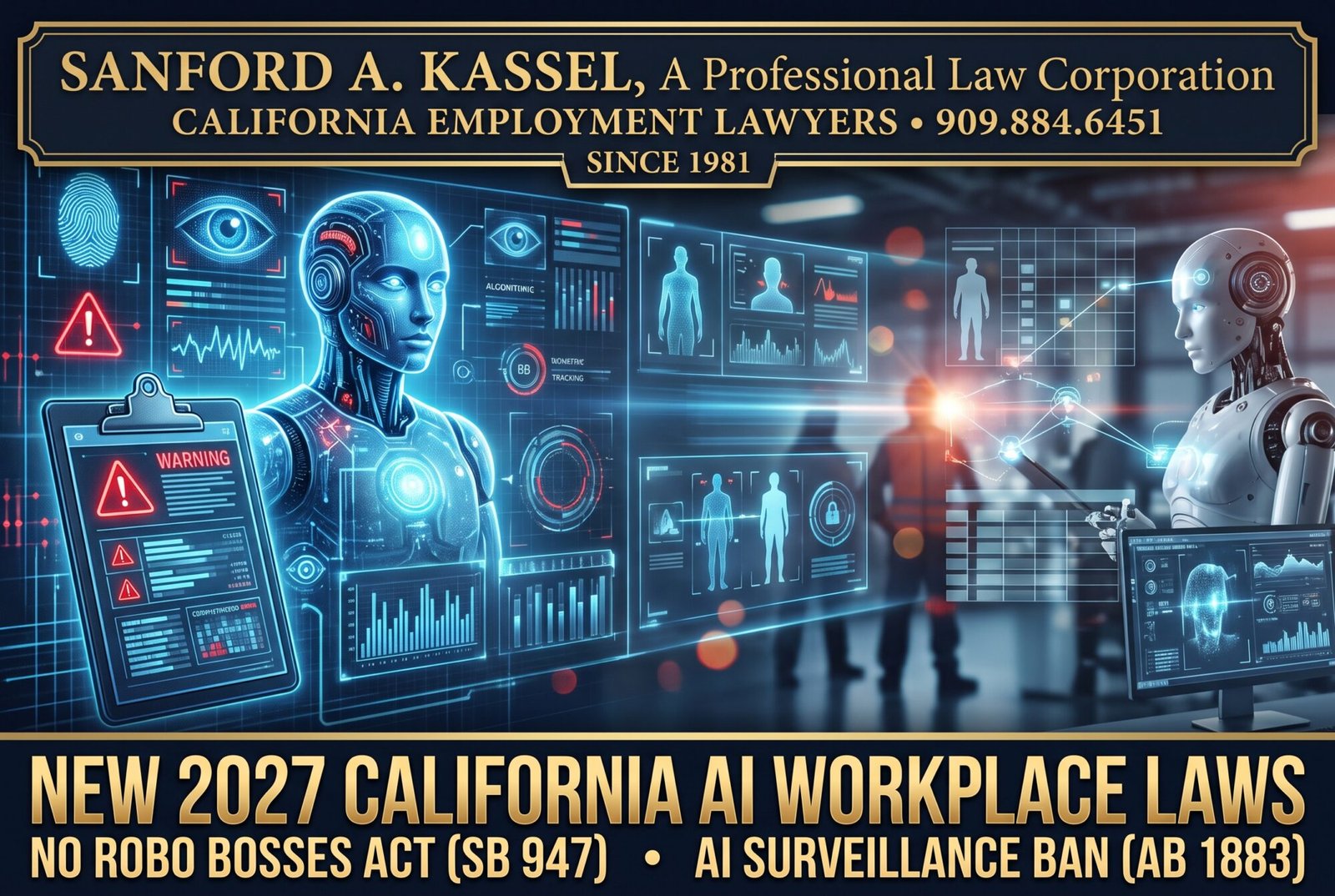
Disclaimer: Attorney Advertising. This article is provided for general informational purposes only and does not constitute legal advice or form an attorney-client relationship. In compliance with California SB 942, this content and accompanying illustration were created with the assistance of AI-Gemini tools and reviewed, edited, and fact-checked by the human team at SANFORD A. KASSEL, A Professional Law Corporation.